
Light visible to humans (visual light) is electromagnetic radiation with wavelengths between approximately 380 and 760 nm.
Below 400 nm, we refer to ultraviolet radiation (UV), which extends as extremely hard UV radiation down to 10 nm. The UV ranges of radiation, which also include sunlight, are designated as UV-B from 280 – 315 nm and UV-A from 315 – 400 nm. The UV-C range extends from 100 – 280 nm.
Above the visible range, we speak of infrared radiation (IR). It encompasses the wavelength ranges from 780 – 2500 nm in the near IR (NIR) as well as the ranges from 2.5 – 50 µm in the mid-IR.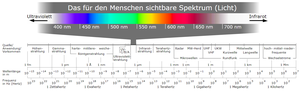
Fig.: Spectrum of electromagnetic radiation showing the range of the light spectrum visible to humans.
.
The properties of light can be described using both wave-like and particle-like characteristics. In industrial machine vision, a variety of phenomena and effects occur that can be derived directly from these characteristics. The light emission of LED lighting is also explained by these quantum mechanical aspects.
The interaction of light with (test) objects can result in the following effects:
– Absorption of certain wavelengths (colors)
– Emission of certain wavelengths (e.g., fluorescence)
– Reflection of incident light
– Generation of interference patterns (usually in a disruptive manner)
– Refraction at surfaces (interfaces)
– Polarization effects
← WikiLED A–Z
WikiLED · LED-Glossar
Light
Light visible to humans (visual light) is electromagnetic radiation with wavelengths between approximately 380 and 760 nm. Below 400 nm, we refer to ultraviolet radiation (UV), …

