
Light guides are transparent, flexible materials, such as fibers, tubes, or rods, through which light is transported. The light is usually transmitted through total internal reflection at the interface of the light guide. For this to occur, the medium surrounding the light guide must have a lower refractive index n or refractive index gradient. Another possibility is the mirroring of the interface.
Light-conducting materials can be plastic (polycarbonate, PMMA, …) or fibers made of glass or quartz glass. High-quality fiber optic cables (light guide cables), such as those used in communications technology, have a high optical density / high refractive index and thus also a small critical angle of total internal reflection.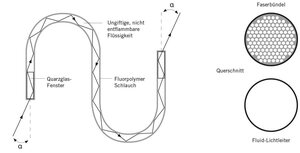 Principle of a (fluid) light guide (Source: Lumatec).
Applications for light guides in machine vision are found where space is limited, in hard-to-reach areas, or under demanding environmental conditions, such as high temperatures or when chemical resistance is required. The light from high-performance LEDs can be specifically transported with light guides over long distances to where it is needed.
Büchner offers light guide systems → here.

