
Abbr. for “Light Emitting Diode”, light emitting diode, luminescent diode.
Used in industrial machine vision in LED illumination systems. LEDs are virtually wear-free. Due to aging (several 10,000 hours), their luminous intensity decreases slightly. Significant (localized) heat buildup causes LEDs to age faster. Adequate cooling must therefore be ensured.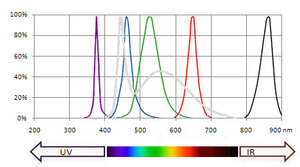 Typical LED spectra (Source: Vision Doctor).
Depending on the semiconductor material, LEDs generate monochromatic (single-color) light. White light is produced either by combining different colored (RGB) LEDs or by converting short-wave light (blue or UV LEDs) into longer-wave light using a phosphor (photoluminescent dye). The color appearance of white LEDs is quantified by the color temperature (in Kelvin).
The luminous flux is nearly proportional to the operating current supplied by a constant current source (regulated power supply) or a lighting controller. In strobe mode (typical on-time < 1 ms), the operating current can be briefly overdriven (up to 10 times).
Further information can be found on Wikipedia.
← WikiLED A–Z
WikiLED · LED-Glossar
LED
Abbr. for “Light Emitting Diode”, light emitting diode, luminescent diode. Used in industrial machine vision in LED illumination systems. LEDs are virtually wear-free. Due to aging (several 10,000 hours), their…

