
Industrial LED lighting systems specifically generate high light intensities to make contours, surfaces, and the smallest features visible. In addition to image quality, the safety of the persons who operate, set up, clean, or maintain a system must also be taken into account.
Optical radiation can damage the eyes and skin depending on the wavelength, intensity, and duration of exposure. Perceived brightness alone is therefore not a reliable measure for safe application. This is especially true for ultraviolet and infrared radiation, which is not visible to humans. Information on optical radiation – LIA NRW
How is photobiological safety evaluated?
An essential basis is DIN EN 62471 “Photobiological safety of lamps and lamp systems.” It distinguishes four risk groups from the Exempt Group RG0 to Risk Group RG3. Different photobiological hazards are evaluated, for example, from UV radiation, blue light, and thermal effects.
A risk group specification applies to the underlying test and operating conditions. These include, in particular, the viewing distance and the duration of exposure. It should therefore not be understood as an unrestricted statement for any installation situation. LEDs and Risk Groups – BAuA
What do the risk groups mean for the application?
The following overview links the classification with possible protective measures. Which measures are actually required results from the evaluation of the specific application.
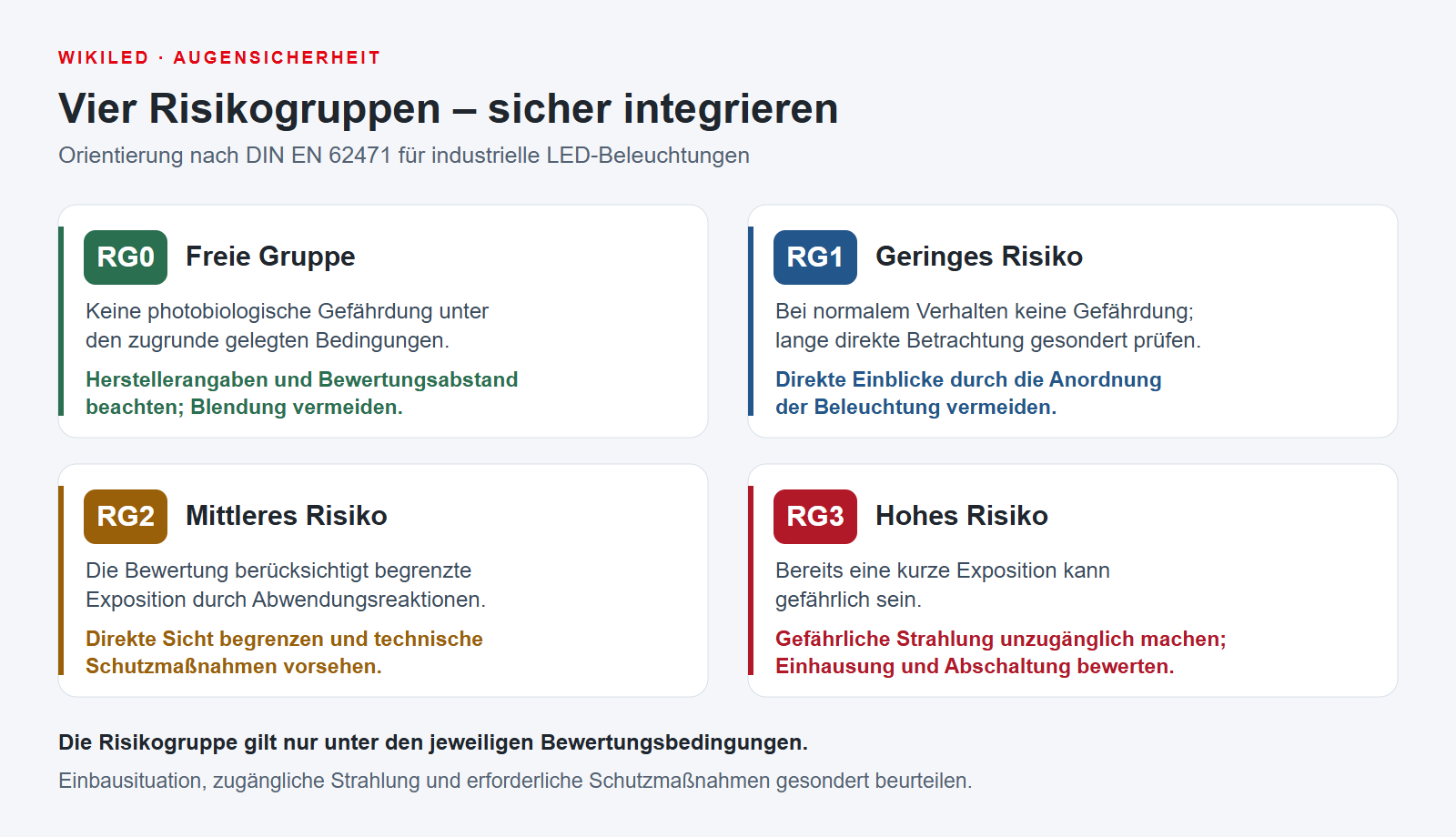
| Risk Group | Meaning under the respective evaluation conditions | Possible measures in industrial applications |
|---|---|---|
| RG0 – Exempt Group | Under the underlying conditions, there is no photobiological hazard. | Observe manufacturer specifications and evaluation distance. Nevertheless, avoid glare and distracting reflections. |
| RG1 – Low Risk | With normal behavior, there is no hazard; prolonged direct viewing may require a different evaluation. | Avoid direct viewing through the arrangement of the lighting and consider longer-lasting adjustment work separately. |
| RG2 – Moderate Risk | The evaluation takes into account, among other things, the limitation of exposure through aversion responses or thermal discomfort. | Limit direct view of the light source, for example, through shields or screening. Define distances, warning notices, and required access restrictions. |
| RG3 – High Risk | Even a short exposure can be dangerous. | Make dangerous radiation inaccessible to persons, for example, through a suitable enclosure and, if necessary, a monitored shutdown when opening. Secure service work separately. |
The classification is based on the explanations of the DGUV on risk groups. The measures mentioned are application examples according to TROS IOS, Part 3.
For RG2, a safe machine design should not rely solely on persons looking away or closing their eyes in time. Especially during setup and control work, prolonged viewing can occur. Furthermore, the risk group of LED lighting is not to be equated with a laser class.
What requirements does machine safety impose?
As of November 2026, the Machinery Directive 2006/42/EC is still generally applicable for machines. Its Annex I, Section 1.5.10, requires that harmful radiation exposure be avoided. This also applies to functional non-ionizing radiation during the adjustment, operation, and cleaning of a machine.
For integrated lighting, this means: The machine manufacturer must assess which radiation can actually reach persons and include necessary protective measures in the design. A warning sticker alone does not replace a necessary technical protective measure. Machinery Directive 2006/42/EC, Annex I
From January 20, 2027, the Machinery Directive will be replaced by the Regulation (EU) 2023/1230 on machinery. The basic requirement for limiting dangerous radiation remains in Annex III, Section 1.5.10. Safe integration of the lighting is therefore also required under the new legal framework. EU Machinery Regulation – consolidated version
Technical protection takes precedence
For workplaces, the Occupational Health and Safety Ordinance on Artificial Optical Radiation (OStrV) specifies the requirements for the protection of employees. Hazards should be avoided or reduced at the source if possible. Technical protective measures take precedence over organizational measures and personal protective equipment.
For an image processing system, the following solutions, for example, come into consideration:
- Position lighting so that employees do not look directly into the light source.
- Use shielding and baffles against direct and reflected radiation.
- Provide a suitable enclosure with necessary interlocking or shutdown functions.
- Mark accessible areas and restrict access if necessary.
- Use suitable personal protective equipment if technical and organizational measures are not sufficient.
The effectiveness of the measures must match the actual hazard. OStrV § 7 – Protective measures
Special features for UV, infrared, and strobe operation
With UV and infrared lighting, visible brightness is missing as a warning signal. A seemingly dark light source can therefore still cause relevant radiation exposure. Protective panes and filters must be suitable for the respective wavelength range; a purely optically dark cover is not sufficient proof of the protective effect. Optical Radiation – LIA NRW, Technical Protective Measures – TROS IOS
Strobe operation is also not automatically eye-safe. In addition to the average radiation, the properties of the individual pulses and the pulse sequence must be taken into account. A short pulse duration or a low duty cycle alone therefore does not prove safe exposure. An evaluation documented for continuous operation must not be transferred to operation with increased pulse current without verification. Pulsed Incoherent Optical Radiation – BAuA
The specific installation situation is decisive
For the assessment, in addition to the product specifications, the accessible viewing positions, distances, exposure times, and possible reflections must be taken into account in particular. Multiple light sources operated simultaneously as well as setup, maintenance, and repair work also belong in the assessment.
The risk group specification of a lighting unit supports this assessment but replaces neither the risk assessment of the machine nor the hazard assessment of the workplace. If the actual exposures cannot be safely assessed based on the available information, suitable calculations or measurements are required. OStrV § 3 – Hazard assessment
Legal status: November 2026.
Büchner Lichtsysteme offers eye safety assessments according to DIN EN 62471.

