
Triangulation is the determination of distance by measuring angles within triangles using trigonometric functions.
If a laser dot (one-dimensional measurement) or a laser line (two-dimensional measurement; light section method) is projected at an angle onto an object, the line or dot is displaced depending on the object’s height. This displacement is a measure of the height and can be recorded by a camera. Through calibration, the displacement (in pixel coordinates) can be converted into world coordinates (e.g., in mm).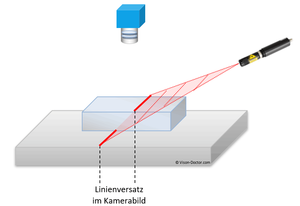 Principle of laser triangulation (Source: Vision Doctor).
The more obliquely (flatter) the laser is projected onto the object, the greater the displacement and the more accurately small height differences can be measured. However, this is only possible within a small measuring or working range. The measurement uncertainty can then be down to a few micrometers.
If the angle of the laser beam hits the object very steeply, large height differences can be measured, but at the expense of lower measurement accuracy.
If objects are moved perpendicular to a laser line, they can be measured three-dimensionally (point cloud).
Due to the oblique incidence of the laser light on the object, shadowing may occur, which is a disadvantage. Measurements cannot be performed in these shadowed areas.
Often, the laser and camera are permanently integrated into a single housing and are then referred to as laser triangulation sensors or 3D scanners.
Comparable measurement methods include the fringe projection technique (Gray code) or the phase shift method (λ/4-shifted sequence of sinusoidal phase grating patterns).
Other optical distance measurement methods typically include time-of-flight measurement for large distances (> 1 m), and laser interferometry or chromatic confocal distance measurement for short distances.
← WikiLED A–Z
WikiLED · LED-Glossar
Laser Triangulation
Triangulation is the determination of distance by measuring angles within triangles using trigonometric functions. If a laser dot (one-dimensional measurement) or a laser line (two-dimensional measurement; light section method) is projected at an angle onto an object, …

