
Telecentric illuminations (or collimated background or transmitted light illuminations or condenser illuminations or condensers) are optics whose light source (usually an LED) is imaged at infinity, whereby a parallel beam path illuminates the measurement object. This achieves improved edge detection and thus higher measurement accuracy in optical metrology. Especially in combination with telecentric lenses, reflections and stray light at the object edges are reduced. The illuminated area and the light intensity remain the same regardless of the working distance.
Telecentric LED illuminations could only be perfectly telecentric if the LED were a point light source with ideal radial radiation characteristics. This is not feasible in practice. For smaller illuminations with high-power LEDs, a telecentricity error of about 0.2° can be achieved. For medium sizes about 0.5° and for large telecentric illuminations about 1-2°.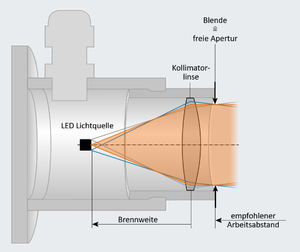 (Source: Sill)
An increase in contrast is achieved by using shorter-wavelength light (blue instead of red light).
← WikiLED A–Z
WikiLED · LED-Glossar
Telecentric Illumination
Telecentric illuminations (or collimated background or transmitted light illuminations or condenser illuminations or condensers) are optics whose light source (usually an LED) is imaged at infinity, whereby a parallel beam path ...

