
Coaxial lighting is a form of diffuse incident light or brightfield illumination. The light from an LED area light is coupled laterally into the camera’s optical path via a beam splitter (semi-transparent mirror) and directed onto the inspection object. This illuminates the object very evenly and free of shadows. The light reflected from the inspection part then passes through the beam splitter to the camera.
Coaxial lights are ideal for highly reflective or translucent materials with relatively flat surfaces. Surface irregularities, such as scratches, embossed characters, and edges, deflect the light sideways and appear dark.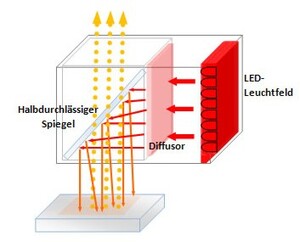 Operating principle of coaxial lighting (Source: Vision Doctor).
Notes:
– A working distance as short as possible, just a few centimeters, is ideal.
– The illuminated field should be significantly larger than the object to be inspected.
– Note that with each pass through the beam splitter, 50% of the light is lost, so only 25% of the original amount of light reaches the camera.
Comparable diffuse incident lighting systems include tunnel lights and dome lights.
← WikiLED A–Z
WikiLED · LED-Glossar
Coaxial Lighting
Coaxial lighting is a form of diffuse incident light or brightfield illumination. The light from an LED area light is coupled laterally into the camera's optical path via a beam splitter and directed onto the…

